
OKFDE|How We Study Real-World Enterprise AI Delivery
A rigorous, field-grounded framework for evaluating system friction, operational accountability, workflow autonomy, and reverse productization.
Published by OKFDE Research • Audience: CIOs, CTOs, Enterprise Architects & Applied AI Builders • October 2026
EXECUTIVE SUMMARY & CORE THESIS: Extracting an invoice with a foundation model is fundamentally different from safely posting a transaction to the general ledger. Between extraction and execution lie corrupted legacy schemas, undocumented verbal side agreements, timing-out interfaces, and ambiguous liability. OKFDE evaluates enterprise AI not by synthetic benchmark scores or vendor marketing, but by observing how autonomous systems navigate the messy physical, technical, and human friction of production workflows. |
00 / THE OPERATIONAL GAP
The Distance Between a Recognized Document and a Cleared Transaction
An optical or multimodal foundation model parses an invoice with sub-second latency. How far is that extracted payload from safely posting to the corporate general ledger?
In practice, that distance is often vast. Between data extraction and financial settlement lies an expanse of operational friction: an unlogged column in a twenty-year-old database, an unwritten pricing exception negotiated verbally over coffee, and a legacy SOAP endpoint that drops TCP connections without confirming whether the payload succeeded. Frontline operators cannot act on probabilistic confidence scores alone. They must know which sources are authoritative, who resolves discrepancies, and who bears personal liability when they click 'Approve.'
OKFDE starts from these ground-level realities. We investigate how enterprise AI actually enters mission-critical business workflows, and the engineering and organizational conditions required for it to run reliably over years rather than weeks.
In our analytical framework, enterprise AI is not defined as an off-the-shelf SaaS subscription, a speculative laboratory prototype, or a marketing rebrand of legacy software. It refers to intelligence embedded directly into the technical and operational fabric of an organization—actively participating in problem definition, workflow restructuring, and production delivery, assuming clear accountability for business outcomes, and systematically compounding battlefield lessons into reusable platform primitives.
This methodology document outlines how we select research subjects, evaluate empirical evidence, categorize workflow autonomy, and reach defensible conclusions. Like the production systems we observe, this methodology is grounded in field evidence and subject to ongoing revision as new data emerges.
01 / RESEARCH SCOPE
The Concrete Deployment as the Fundamental Unit of Analysis
OKFDE anchors all research in specific business workflows and their concrete deployments. We do not evaluate foundation models as isolated algorithms; we evaluate them as components wired into enterprise environments.
Studying a financial reconciliation system requires mapping the exact document classes it handles, the legacy databases it queries, who holds signature authority, and how edge-case exceptions are routed. Evaluating an automated manufacturing dispatch engine requires knowing which physical constraints it can alter, who authorizes shift overrides, and how runtime execution telemetry feeds back into planning.
Operational boundaries define what capability claims actually mean. The exact same frontier model, deployed across two different enterprise IT environments, will operate under radically different permission topologies and assume entirely different corporate risks. In Environment A, with clean REST APIs and modern IAM, an agent may achieve high autonomy. In Environment B, constrained by air-gapped on-premise servers and fragile SOAP middleware, the exact same model may introduce unacceptable operational risk.
Consequently, OKFDE strictly segments its observations into three operational tiers:
·1. Prototypes & Sandboxes (Demos): Evaluations conducted in synthetic, curated, or isolated test environments. Validates architectural intent, but provides zero evidence of production viability.
·2. Scoped Deployments (Pilots): Systems running on live business data within a constrained department, region, or SKU category, accompanied by dedicated human supervision.
·3. Unassisted Production Operations: Autonomous systems handling live business volume under standard operational SLAs, with full exception handling and formal liability allocation.
Performance observed within a sandbox supports claims strictly within that sandbox. Assessing a vendor's overarching enterprise capability demands sustained, verifiable production records across multiple enterprise accounts.
02 / THE EVALUATION RADAR
Three Interrelated Dimensions of Production AI Durability
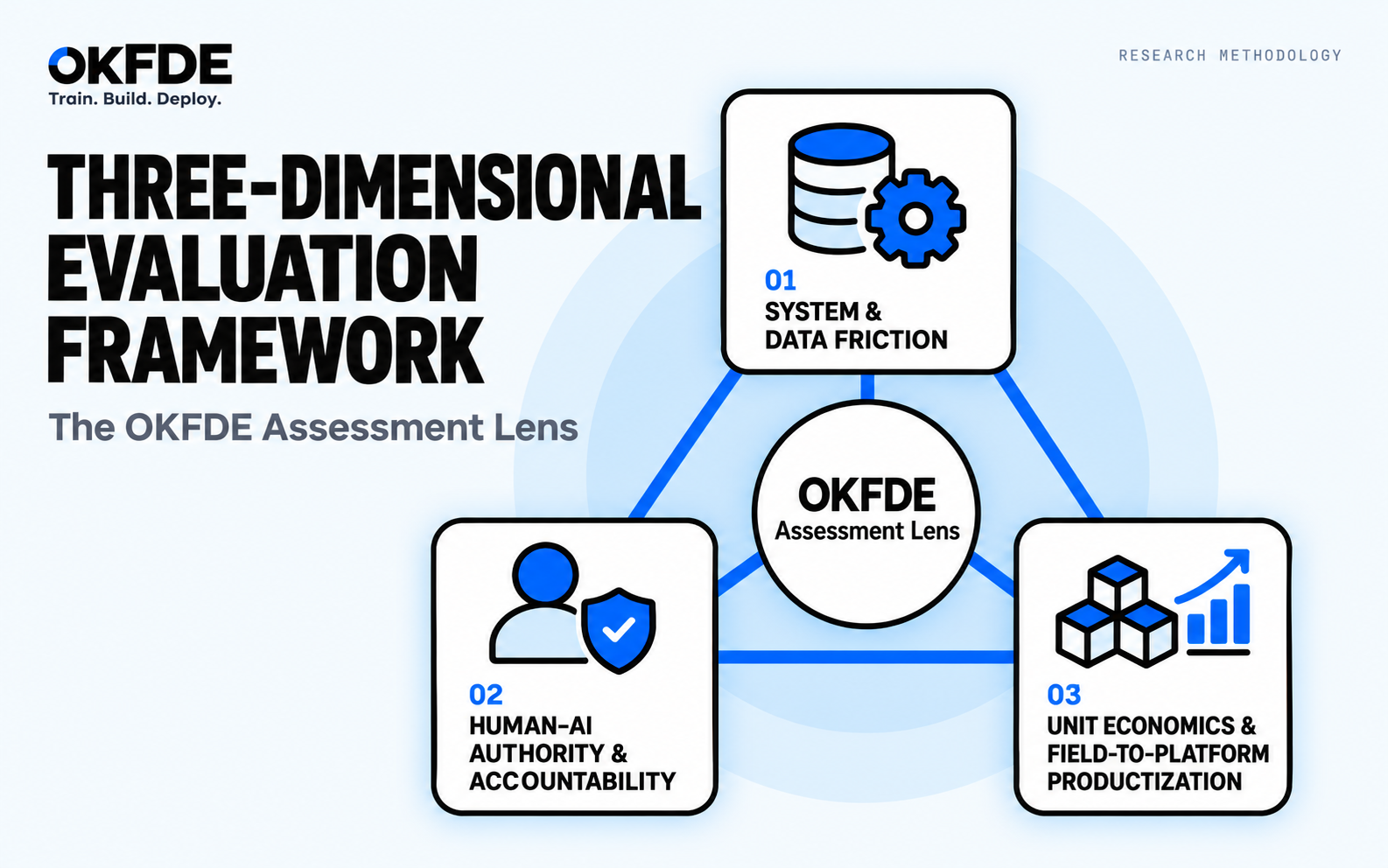
Once the boundaries of a specific workflow are mapped, OKFDE analyzes the deployment across three structural dimensions:
Dimension 1: System and Data Friction
Enterprise data arrives with specific physical origins and systemic flaws: degraded scans, missing historical database keys, ambiguous abbreviations, and conflicting nomenclature across departments. We examine whether an AI system recognizes these boundary conditions and safely halts when evidence is incomplete.
·Strict Data Provenance: For document and multimodal workflows, we verify whether outputs trace back to exact source coordinates—specific page numbers, verbatim text spans, or bounding boxes. Low-confidence extractions must be explicitly surfaced. Unverifiable verbal agreements or informal Slack promises require human attribution; text extraction alone cannot transform a chat message into an authorized business rule.
·Integration Topography: We track a transaction from raw input to final ERP writeback, recording every manual swivel-chair intervention and newly introduced operational burden. Standalone web portals, native REST/SOAP connectors, and robotic desktop automation (RPA) each introduce distinct failure modes. Key criteria include access token management, resilience to upstream schema drift, and the ability to inspect failed execution states.
·Execution Boundary Defenses: When AI triggers system state changes, we inspect its boundary controls: How are probabilistic outputs validated against deterministic rules? Does the API gateway independently enforce least-privilege RBAC? When a write operation times out mid-flight, how does the system confirm whether the database mutation succeeded? We evaluate protections against double-writes, read-only state probing, rollback mechanics, and immutable audit logs.
Dimension 2: Human-Machine Accountability & Organizational Adoption
The operational depth of AI dictates the required authorization and supervision structures. Drafting internal documentation carries fundamentally different legal and financial risks than triggering an automated disbursement.
·Substantive vs. Theatrical Confirmation: A confirmation dialog with an 'OK' button does not constitute meaningful human oversight. We evaluate whether operators are provided with underlying evidence, whether they have adequate time to review edge cases, and whether they possess the authority to reject or override recommendations inline without operational friction.
·Frontline Behavioral Proxies: Real enterprise adoption is observed in frontline working habits, not software license activations. Is the shadow 17-tab Excel sheet still being updated on the operator's desktop? Have physical paper printouts actually decreased? Have cross-departmental escalations shifted? We treat these habits as proxy indicators, cross-referencing them against operational logs and operator interviews.
·Outcome Attribution: High API ping volumes and daily active users (DAUs) only demonstrate that software is running. Business value requires measuring total wall-clock cycle time, rework rates, exception volume, and error frequencies before and after deployment.
Dimension 3: Unit Economics & Reverse Productization
After an engagement solves an immediate operational problem, we ask the decisive engineering question: Does the next deployment compound in velocity and reliability, or did the team merely accumulate bespoke technical debt?
·Reverse Productization: Field-hardened connectors, domain ontologies, and evaluation suites possess reusable potential. Whether they constitute genuine product assets depends on verified reuse across subsequent deployments. We track how much code requires bespoke modification during reuse, who maintains it, and whether engineering hours per deployment decline.
·Dual-Perspective Unit Economics: Economics must be analyzed from both buyer and vendor perspectives. The buyer evaluates total cost per successful transaction, end-to-end turnaround time, and error risk. The vendor evaluates upfront implementation capital, recurring support costs, and the ratio of engineering headcount to recurring software revenue.
·Verified Transaction Denominator: In calculating unit cost, OKFDE strictly defines the denominator as transactions successfully completed and accepted under formal business criteria. Human review labor must be fully burdened into transaction cost. Resources consumed by failed executions, retries, and manual reconciliations must be accounted for, and upfront delivery expenses amortized transparently.
03 / THE EVIDENCE TRIAD
Separating Observed Facts, Research Interpretations, and Working Hypotheses
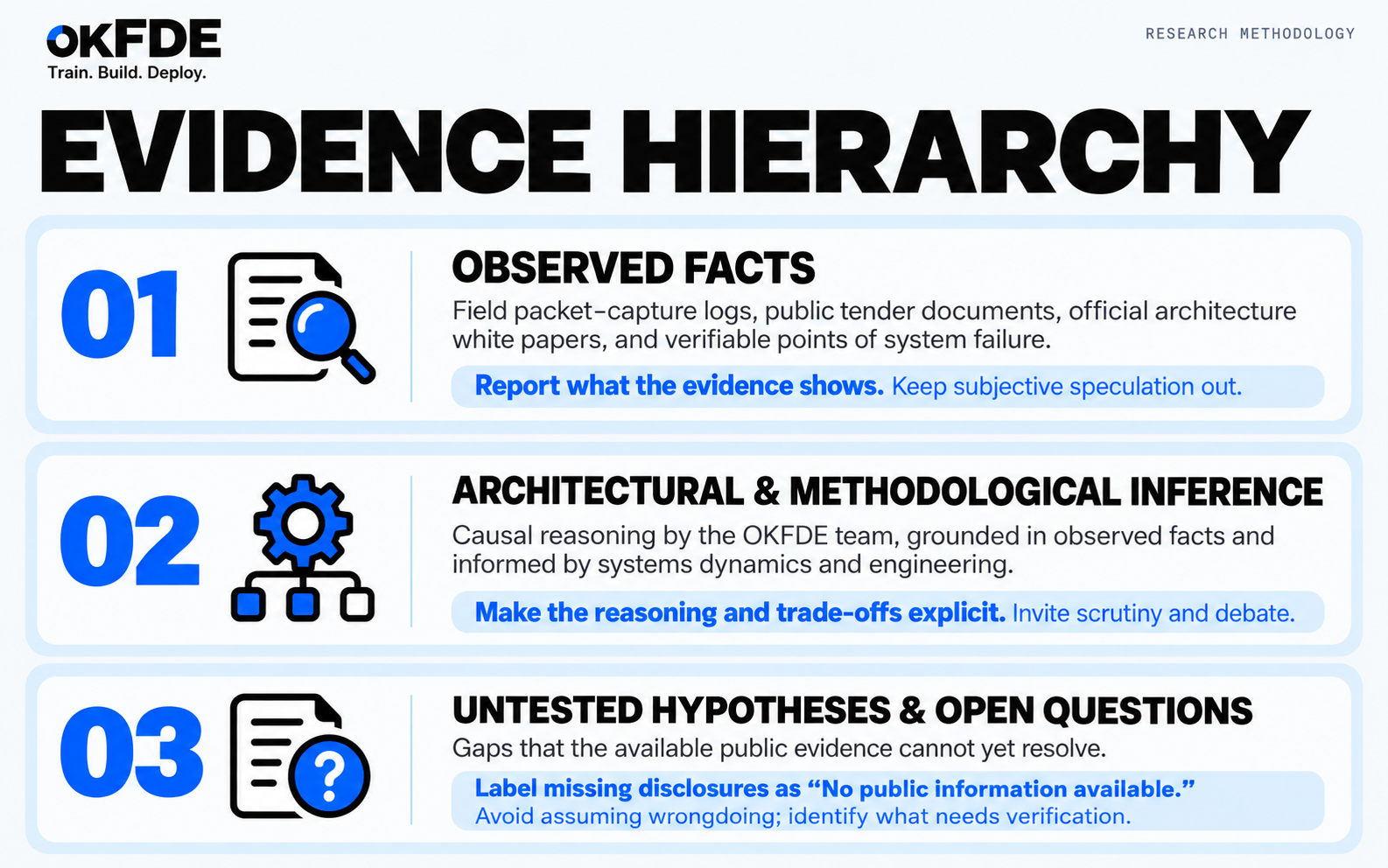
To prevent marketing rhetoric, vendor PR, and theoretical claims from polluting enterprise research, OKFDE partitions all research statements into three explicit epistemological categories:
·1. Observed Facts : Empirical data directly substantiated by primary source material, accompanied by specific origin, timestamps, and scope boundaries. Tender documents prove buyer requirements; technical documentation proves vendor architectural intent; neither proves production capability without operational logs or live observations.
·2. Research Interpretations : Engineering analyses, failure-mode syntheses, and organizational assessments derived by OKFDE researchers from observed facts. We document the causal logic connecting fact to conclusion, disclose assumptions, and evaluate alternative interpretations. A workflow accelerating post-deployment does not prove AI causation; seasonal volume swings and simultaneous process adjustments must be addressed.
·3. Working Hypotheses & Open Questions : Unresolved questions that current empirical evidence cannot settle, along with the specific data required to resolve them. Where vendor access designs, production uptime, or true cost structures are undisclosed, we state 'No public or verified data available.' Incomplete disclosure is neither proof of capability failure nor a license for optimistic speculation.
04 / WORKFLOW AUTONOMY TAXONOMY
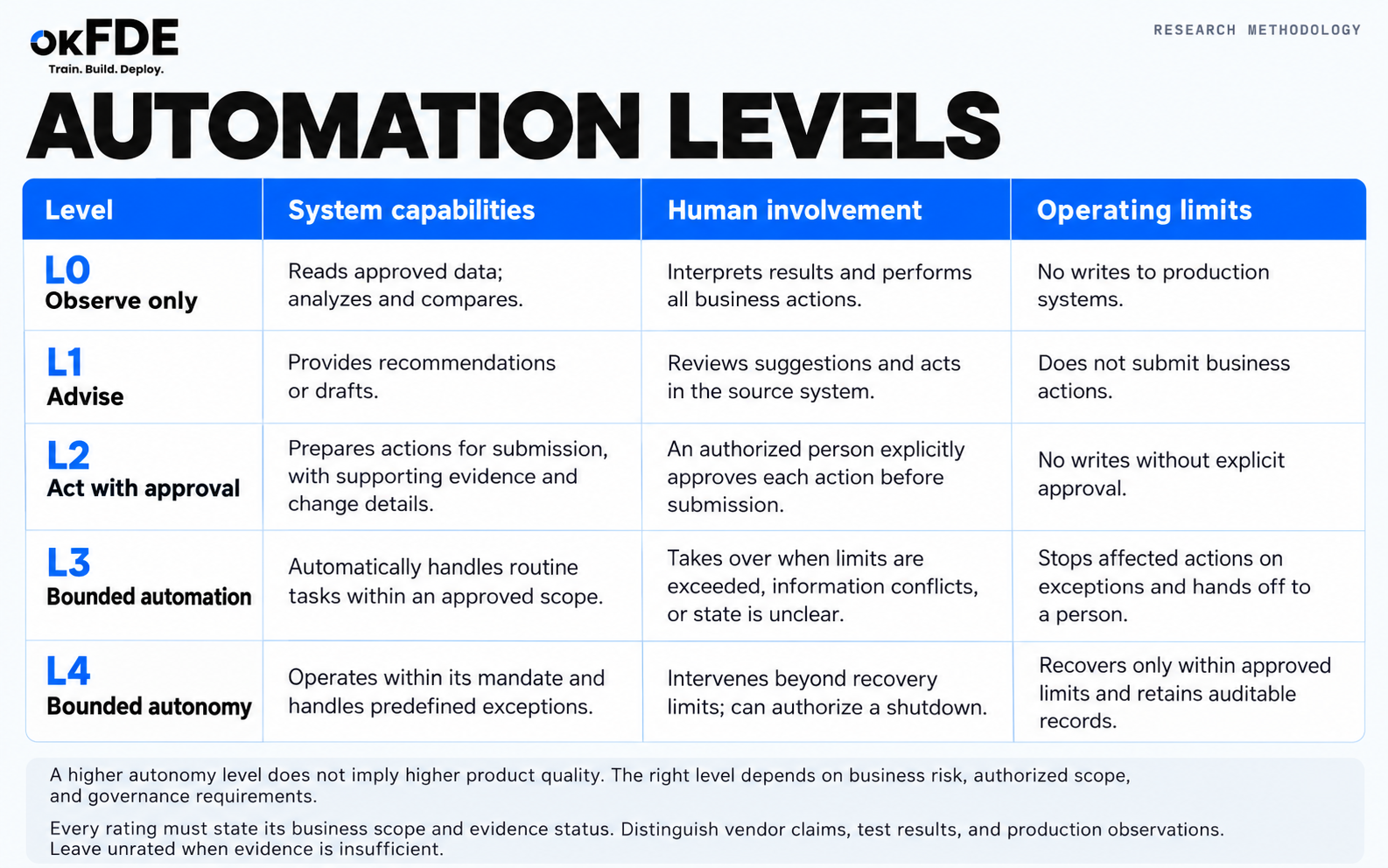
The Five Levels of Workflow Autonomy (L0 to L4)
To provide an objective, standardized vocabulary for describing AI execution within enterprise workflows, OKFDE employs a five-tier autonomy classification (L0 through L4).
This classification applies strictly to a clearly defined business workflow, not to an entire company or software suite. A platform might operate at L4 in log categorization while operating at L1 in treasury disbursement. Crucially, higher levels are not inherently superior: retaining L2 human-in-the-loop verification on seven-figure disbursements is disciplined enterprise risk management, not a technical defect.
Classification Governance Rules:
·Environment Sensitivity: An autonomy level is valid only within the explicitly observed client environment and declared scope.
·Evidence Grounding: Classifications must cite verifiable proof (vendor technical documentation, staging test runs, or production telemetry).
·The 'Pending Verification' Protocol: When public or audit materials are insufficient to confirm execution boundaries, the workflow is explicitly classified as 'Unrated (Pending Verification)'—never defaulted to L0.
05 / RESEARCH GOVERNANCE
Evidence Lineage, Commercial Independence, and Continuous Revision
Every OKFDE research project begins by isolating a specific engineering problem and defining falsifiable evaluation criteria. We collect materials that can both corroborate and refute our preliminary models.
·Evidence Lineage: Every published conclusion must preserve direct traceability back to its supporting evidence. A reader should be able to audit which empirical logs supported a finding, which components represent research interpretation, and which boundary conditions remain unverified.
·Independent Triangulation: Critical claims require corroboration across multiple independent sources. A single marketing case study or a vendor press release cannot substantiate an architectural capability. Public data is augmented through technical interviews and authorized operational observations.
·Commercial Independence & Conflict Disclosure: OKFDE maintains complete editorial independence. We do not accept paid placements, sponsored vendor rankings, or pay-to-play benchmarks. When examining workflows involving advisory clients or research partners, all commercial relationships are explicitly disclosed. Furthermore, confidential data protected under enterprise NDAs cannot be used to justify claims in public research reports; all public findings must rest on explainable, public evidence.
·Continuous Errata & Revision Protocol: When vendors or operators present verified evidence that contradicts our published analysis, we investigate and update the report. Substantive modifications are documented in a publicly accessible revision log with timestamps, preventing conclusions from drifting away from empirical reality.
06 / COLLABORATION & CONTACT
Contributing Field Telemetry and Engaging with OKFDE
OKFDE actively invites enterprise engineering teams, forward deployed engineers, and enterprise architects to share verifiable field insights that help calibrate our industry research.
We are particularly interested in integration logs with legacy ERP/CRM systems, post-mortems of agentic writeback failures, and empirical before-and-after operational telemetry. Contributors must respect enterprise data privacy: do not submit unredacted customer PII, confidential trade secrets, or proprietary business data.
OKFDE ENGAGEMENT CHANNELS Research Intelligence & Case Submissions: leo@okfde.com Official Publication & Field Notes: https://okfde.substack.com | https://okfde.net Core Operating Philosophy: Train. Build. Deploy. |