
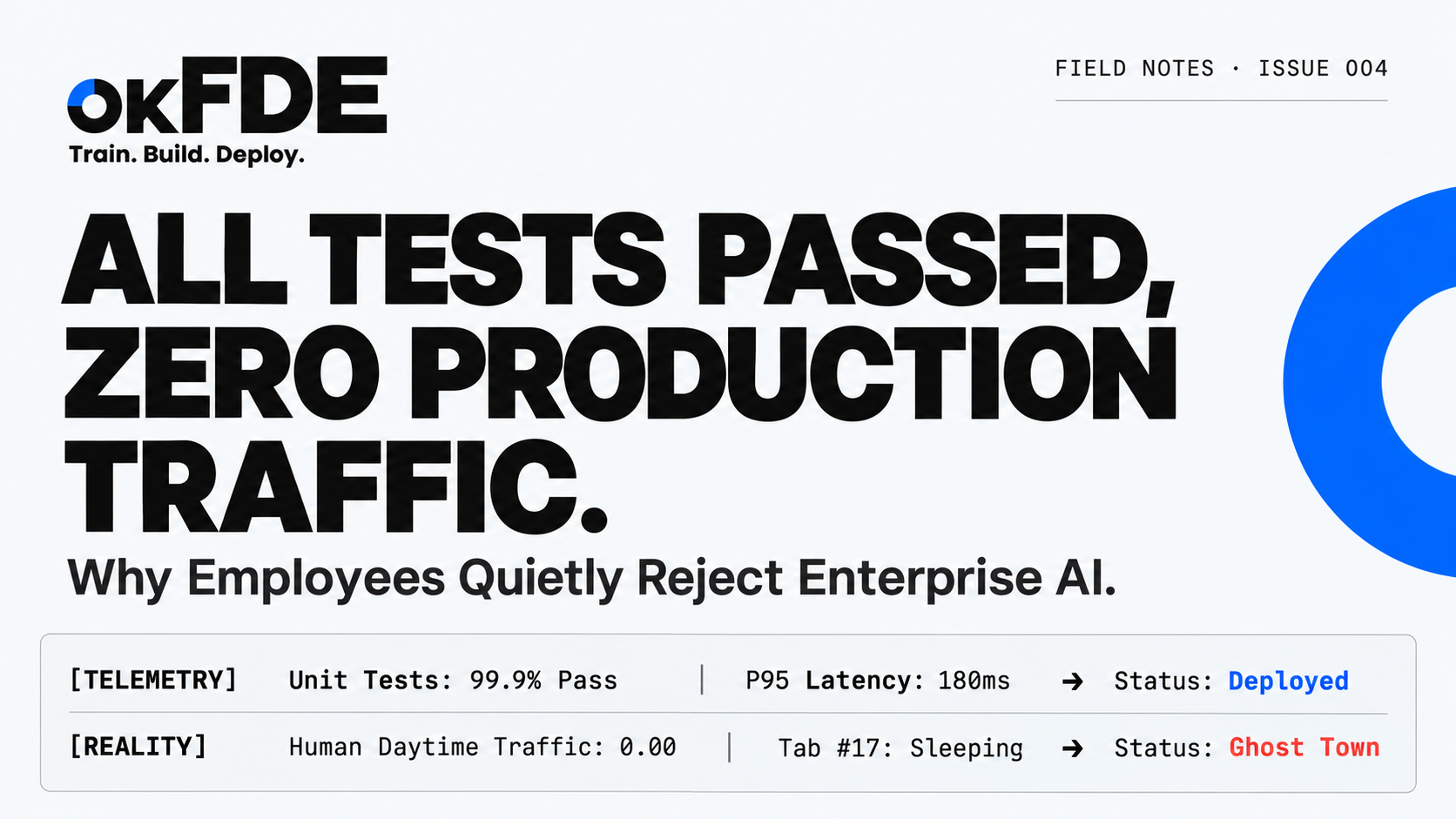
OKFDE FIELD NOTES #004|All Tests Passed, Zero Production Traffic: Why Employees Quietly Reject Enterprise AI
Unit test coverage is 99.9% and inference latency is under 200ms, yet Clara’s mouse hasn't clicked the new portal since week two.A field post-mortem on swivel-chair friction, and invisible integration.
OKFDE Research · Published October 2026 · ~11 min read
KEY TAKEAWAY
Enterprise AI deployments rarely die in dramatic public arguments. They die in silence. Frontline operators open the new AI portal at 9:00 A.M. to satisfy corporate tracking, minimize it to the seventeenth browser tab, and spend the rest of the day working inside their legacy ERP and private spreadsheets. Overcoming silent rejection requires eliminating swivel-chair friction, shielding operators from asymmetric liability, and embedding intelligence invisibly inside the interfaces where work already happens.
COLD OPEN
The ghost town after the launch party
The user acceptance sign-off could not have gone more smoothly. At the milestone review, Alex—the VP who championed the initiative—shook hands with the engineering pod in front of a glowing corporate-blue slide deck.
Engineering celebrated in Slack. Unit test coverage sat at 99.9%. P95 inference latency was locked under 190 milliseconds. The account executive sent a triumphant wrap-up email declaring the deployment delivered on time, on budget, and above benchmark.
Six weeks later, Leo opens the production telemetry dashboard.
The daily active request curve has traced a clean, uninterrupted ski slope down to the floor. Aside from the automated health-check cron job pinging the endpoint at 3:00 A.M. every night, daytime traffic from actual human operators is effectively zero.
Every technical metric is green. And production is a ghost town.
01 / FRICTION
Packet Sniffing on the Floor: The Seventeenth Browser Tab
Leo packs his backpack and heads back to the client’s office.
His borrowed folding desk is still wedged near the pillar. Across the aisle, Clara’s frayed mousepad is in its usual spot. On her monitor sits the same fifteen-year-old legacy ERP, while unread Slack badges pulse in the corner.
The bespoke AI web portal that the engineering team spent two months polishing is tucked safely away in the seventeenth tab of her browser, fast asleep.
Leo pulls up his folding chair. “Clara, is the new review portal giving you trouble?”
Clara takes a sip of tea from her insulated mug, nudges the mouse toward Leo, and gestures at the screen. “Try clearing one order with it yourself.”
Leo clicks Tab 17. The first obstacle appears immediately: Session Expired. Please re-authenticate.
Clara picks up her phone and waits for an SMS two-factor code. She types the six digits. The spinner turns three times and pops up a modal asking her to select her Organizational Business Unit and Cost Center.
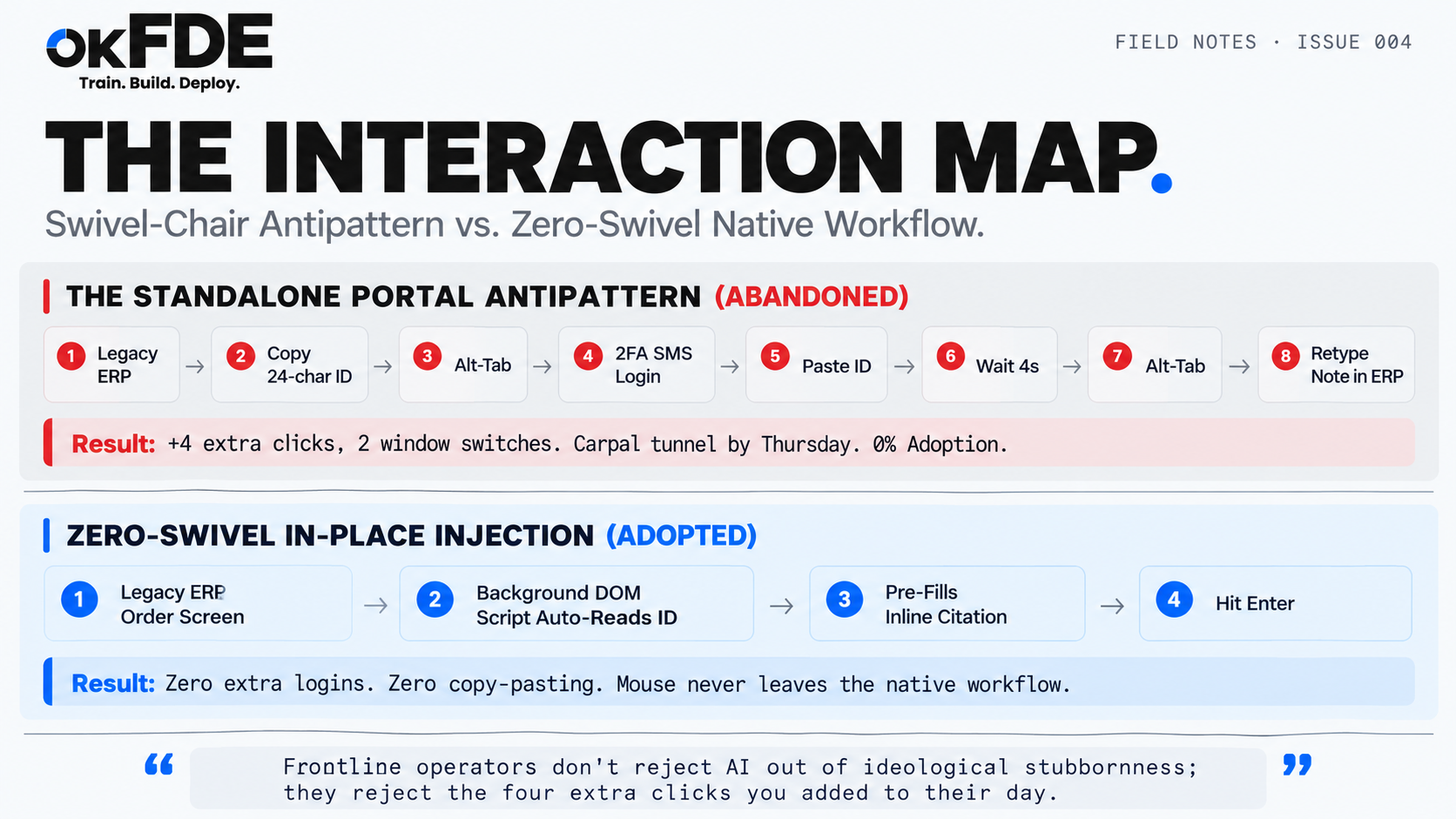
Once inside the dashboard, Clara alt-tabs back to the legacy ERP, carefully highlights a 24-character alphanumeric purchase order ID, presses Ctrl+C, alt-tabs back to Tab 17, pastes it into the search bar, and hits Enter.
The foundation model whirs to life. Four seconds later, the screen renders a beautifully formatted risk assessment.
Clara leans in, scans the summary for two seconds, closes the tab, alt-tabs back to the legacy ERP, manually types Verified per contract terms into the ERP’s approval remarks box, and clicks Save.
Leo stares at the screen.
Clara turns to him. “Do you see the math? In the old ERP, clearing a standard order takes me two clicks. To use your AI system, I have to wait for a text message, select my department, and copy-paste a 24-character string twice. I process eighty orders a day. If I use your portal, I’ll have carpal tunnel by Thursday.”
In the server room, the engineering team thought they built an autonomous reasoning engine. At the operator’s desk, they built a three-step manual data-entry tax.
02 / LIABILITY
Asymmetric Risk and the Rationality of Silent Rejection
When enterprise software fails to gain adoption, engineering retrospectives love to blame “organizational inertia” or complain that frontline staff “lack a digital mindset.”
That diagnosis is comforting, and almost entirely wrong.
Frontline operators rarely write angry manifestos protesting a new AI tool. They don’t pound the table in weekly all-hands meetings. Their resistance is completely silent: they log into the portal at 9:02 A.M. so the compliance report shows 100% seat activation, minimize the window, and spend the next eight hours running the business on spreadsheets and Slack DMs.
Beneath that silent rejection lies a ruthless, mathematically rational calculation of workplace survival.
Foundation models are probabilistic. Even if an evaluation benchmark hits 98% accuracy in staging, what happens when the remaining 2% failure rate materializes in production on a Tuesday afternoon?
Suppose the AI hallucinates an approval recommendation on a non-standard discount, the order ships, and Finance discovers a $30,000 revenue leak at month-end close. When Alex storms down to the floor demanding accountability, the vendor’s machine learning team will post a polite update in Jira: “Logged bad sample to negative training set; prompt tuning scheduled for Sprint 14.”
A foundation model cannot have its quarterly bonus docked. A Python script does not get called into HR.
The person whose employee ID is stamped on the final ERP commit—and the person who signs the incident post-mortem—is Clara.
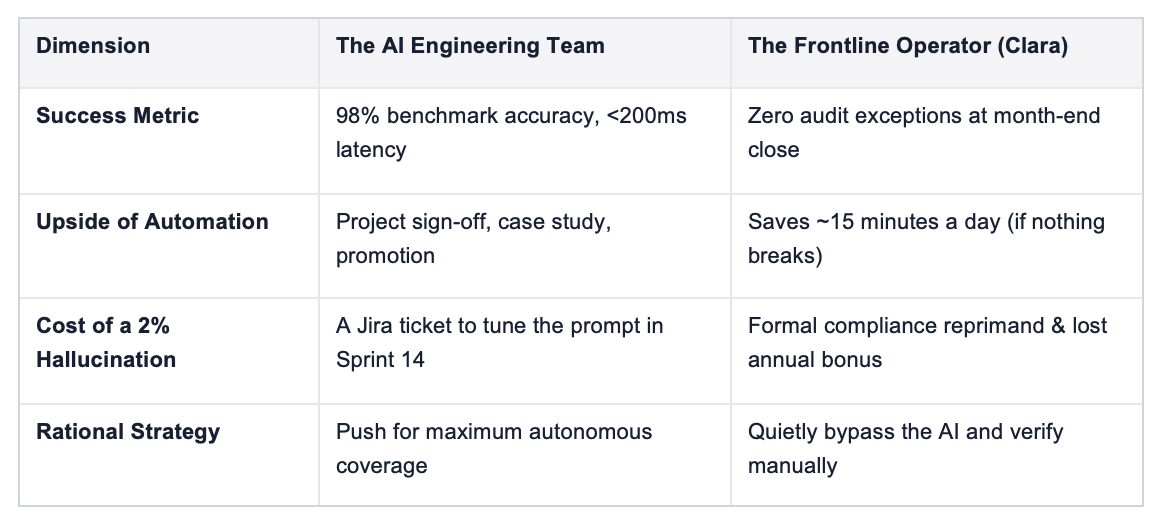
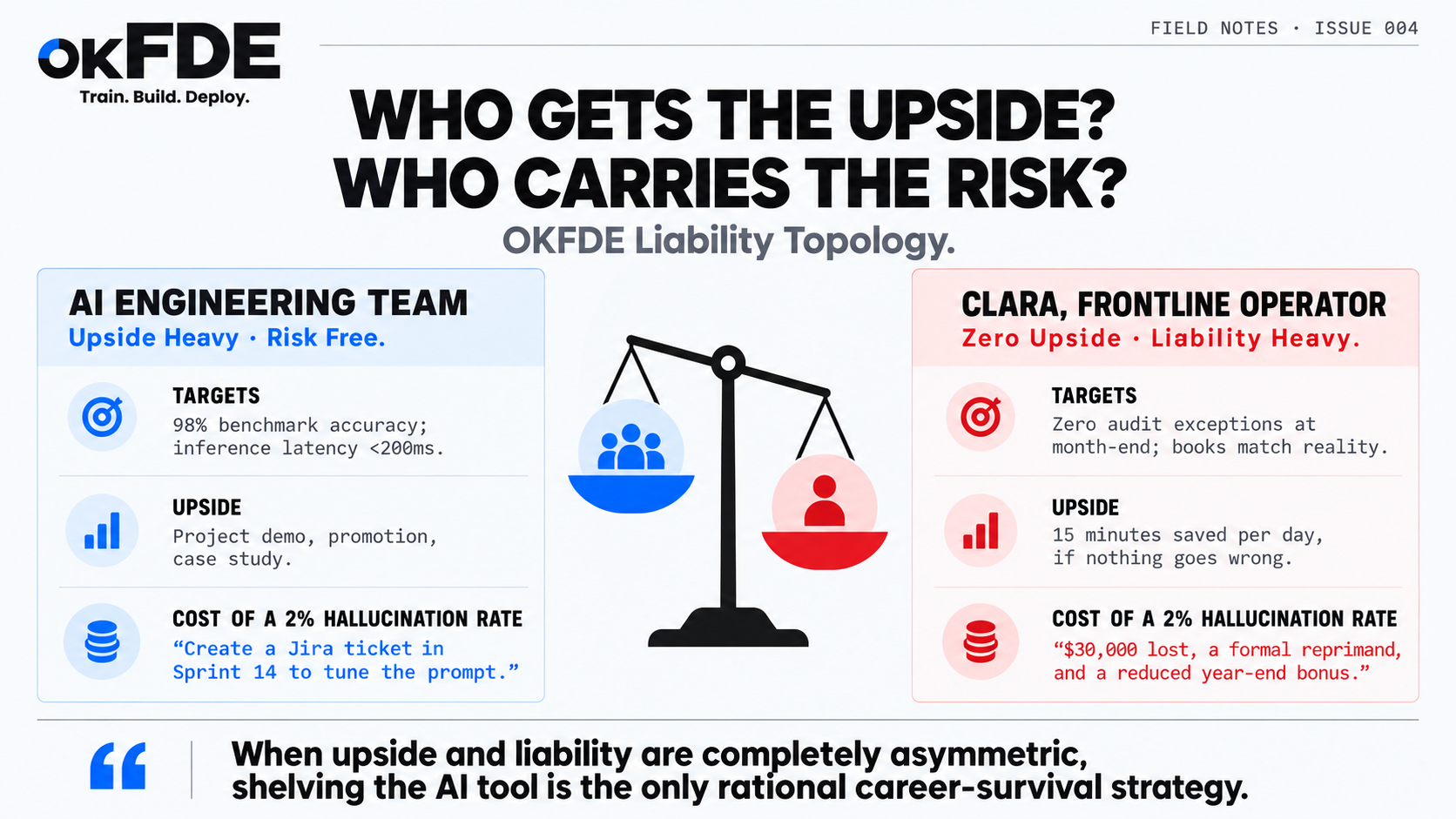
When upside and liability are this asymmetric, shelving the shiny new AI tool is the most rational risk-management strategy in the building. Checking orders the old way is tedious, but Clara knows she looked at every line item herself, and she sleeps soundly at night. If a software system cannot absorb or shield the operator’s liability, the operator will quietly eject the software.
03 / EXCEPTIONS
Tacit Rules and the Exception Storm
People who draw workflow diagrams in headquarters conference rooms operate inside an idealized mental model of the enterprise.
In that model, purchase orders arrive with standardized schemas, unit prices match the master catalog, and legal addenda carry crisp digital signatures.
At an actual operations desk, daily work is an unending storm of exceptions:
• A ten-year distributor calls in an urgent replacement order for a downed assembly line, promising that the countersigned PDF addendum will arrive from legal on Monday.
• A regional sales director verbally bundles a batch of spare consumables to close a quarter-end deal, while the formal CRM quote amendment is still stuck in Deal Desk review.
None of these operational realities exist in a clean SQL column. They live in forty-second voice notes, in tribal memory, and on yellow sticky notes stuck to the bezel of Clara’s monitor.
The initial version of the automated workflow enforced the written SOP with robotic literalism. The moment it detected a missing wet-ink signature or an unlogged spare-parts bundle, it flashed a red error banner and hard-blocked the order.
The more rigid the automation, the worse the operational gears ground to a halt. Orders that Clara used to resolve with a ninety-second phone call to Sales were now deadlocked in the system. Account executives were blowing up Slack demanding to know why shipments were frozen, customers were threatening to cancel, and Alex’s executive assistant walked down to ask why weekly order velocity had dropped by 30%.
Under that pressure, nobody has time to admire a well-prompted agent. The team immediately formed an unspoken pact: bypass the automated pipeline entirely, spin up a side-channel Slack group, and push the orders through by hand.
When an AI system treats real-world business friction as an illegal syntax error, the business treats the AI system as a roadblock.
04 / INTERVENTION
Make the System Disappear: Stealing Back Keystrokes
Once Leo understands why Tab 17 is gathering dust, the fix has nothing to do with scheduling another user-training webinar.
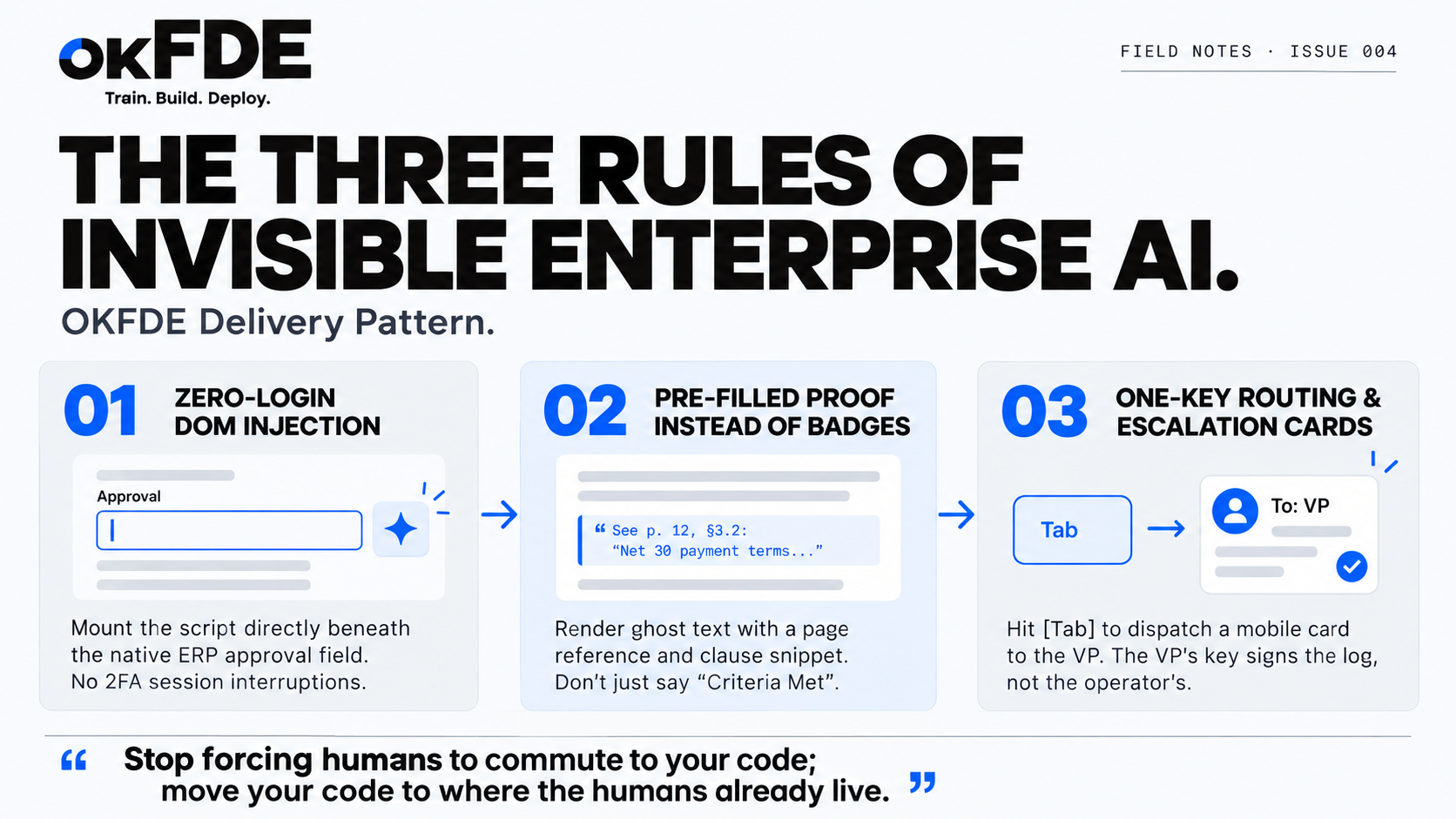
The core rule of frontline adoption is simple: stop forcing humans to commute to your code; move your code to where the humans already live.
Over the next seventy-two hours, Leo and the deployment pod decommission the standalone web portal they spent two months building.
[Standalone Portal Anti-Pattern (Abandoned)]
Legacy ERP ➔ Copy 24-char ID ➔ Alt-Tab ➔ 2FA Login ➔ Paste ID ➔ Wait 4s ➔ Alt-Tab ➔ Retype Note

[Zero-Swivel In-Place Injection (Adopted)]
Legacy ERP Order Screen ➔ DOM Script Auto-Reads ID ➔ Pre-Fills Note + Inline Contract Snippet ➔ Hit Enter
Since Clara’s entire working life happens inside the legacy ERP, every ounce of AI capability must be compressed directly into that legacy interface:
1. Zero-login DOM injection: The team deploys a lightweight frontend script that mounts directly beneath the approval remarks box inside the legacy ERP’s order detail screen. Clara logs into her ERP once in the morning; she never sees a second login screen or an SMS code.
2. Pre-filled evidence, not terse badges: When Clara clicks an order, the background service silently scrapes the order ID, cross-checks the contract repository, and pre-populates the ERP remarks field in light grey text with the exact contract clause citation. A floating thumbnail right beside the cursor shows the highlighted PDF page. If it’s a clean standard order, the Approve checkbox is pre-selected—Clara glances at the snippet and hits Enter.
3. One-keystroke exception routing: When the system encounters a verbal discount or a pending addendum, it no longer throws a blocking red error. Instead, it renders a calm inline prompt below the input box: “Historical verbal override pattern detected. Press [Tab] to dispatch mobile sign-off card to Regional VP.” Clara hits one key, the system packages the sanitized context card to the VP’s phone, and the moment the VP taps Approve in transit, the ERP hold releases automatically—with the VP’s cryptographic signature attached to the audit log, not Clara’s.
No seventeenth browser tab. No 24-character copy-pasting. No taking the fall for an executive override.
The entire engineering intervention had a single North Star: save Clara four keystrokes and three window switches on every order.
05 / MEASURE
How to Tell If an Enterprise System Is Actually Being Used
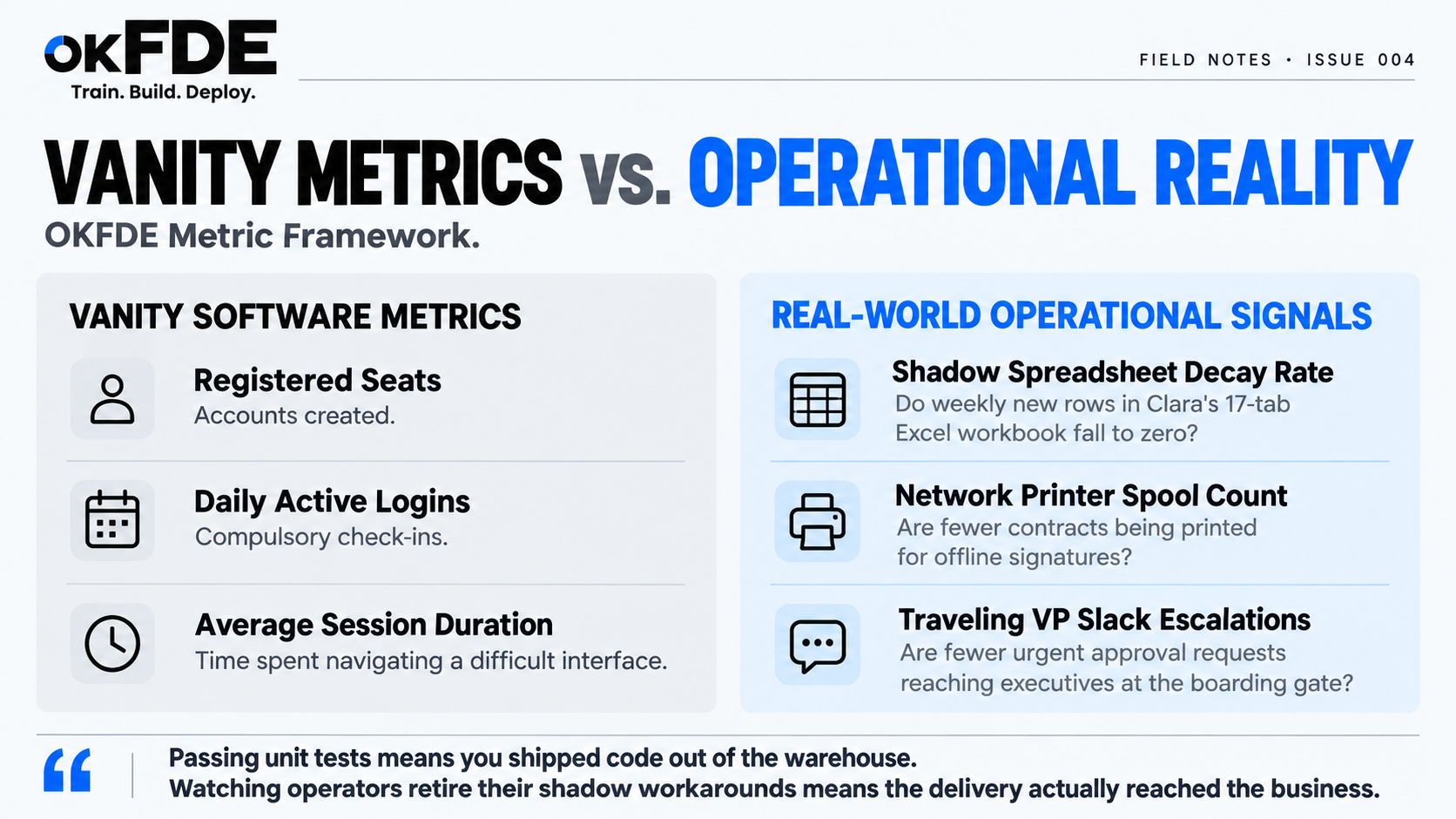
Vendor pitch decks love to report “Registered Seats,” “Page Views,” and “Average Session Duration” as proof of successful adoption.
Inside an enterprise workflow, those metrics are almost always vanity mirages.
In B2B operations software, longer session duration usually means your UI is confusing. High daily login counts often just mean a VP sent an email threatening to track compliance.
If you want to know whether an AI deployment has actually been absorbed into the bloodstream of a company, stop looking at the web analytics dashboard and start looking at physical proxy signals on the operational floor:
• The Shadow Spreadsheet Decay Rate: Look at the local Excel file on Clara’s desktop where she tracks tricky orders. Has the number of newly appended rows per week started dropping toward zero?
• The Network Printer Spool: Check the shared laser printer in the corner of the back office. Has the stack of paper contracts printed out for physical walk-around signatures visibly shrunk?
• The Traveling Executive Bottleneck: When Alex or the Regional VP is on a flight, have the frantic Slack pings asking when they will be back in the office to clear held orders quieted down?
Those unglamorous physical details outside the monitor are the only honest barometers of enterprise AI adoption. Passing unit tests means engineering shipped code out of the warehouse; watching operators retire their shadow workarounds means the delivery actually reached the business.
06 / RETURN TO REALITY
Two weeks after the inline ERP script goes live, Leo returns to the floor for a maintenance check.
The open office is quiet. Nobody is jogging between cubicles waving printed purchase orders.
Clara is leaning back in her chair drinking tea, scrolling smoothly through the legacy ERP queue. Her famous 17-tab Excel workbook is minimized on the far right of her taskbar; its Last Modified timestamp is from the previous Friday.
Alex walks past the aisle with a cup of coffee and pauses by her desk. “Clara, how is the new batch of regional orders moving this week?”
Clara looks up and smiles. “Pretty smooth. I haven’t had to stay past 5:30 to reconcile order notes all week.”
Alex nods and walks back to his office. Neither of them mentions the foundation model, the vector retrieval pipeline, or the acronym-heavy system name from the kickoff slide deck.
Leo crouches beside the pillar, unplugs his Ethernet cable from the floor jack, coils his power adapter into his backpack, and zips it shut.
When an enterprise AI system is treated like electricity and running water—so natural that nobody on the floor remembers it is “high tech”—the Forward Deployed Engineer’s job is done.
NEXT / FIELD NOTES · 005
From Manual Reconciliation to Autonomous Resilience: The Four Real Stages of Enterprise AI
Now that order approvals are running smoothly, Alex has drawn a massive “Fully Autonomous Supply Chain Brain” on the executive whiteboard—right as a burst pipe floods the warehouse’s paper delivery slips. A field guide to the four evolutionary steps every enterprise must climb before autonomy is safe.
SOURCES & EVIDENCE
This Field Note synthesizes recurring adoption failure modes observed across enterprise AI deployments. Narrative scenes and characters are composite illustrations of OKFDE engineering methodology:
[1] Mark Weiser — The Computer for the 21st Century (Scientific American, 1991). Establishes the foundational principle of ubiquitous computing: the most profound technologies are those that weave themselves into the fabric of everyday work until they are indistinguishable from it.
[2] Nielsen Norman Group — Swivel-Chair Integration & Cognitive Friction in Enterprise Software (2023). Documents the severe productivity and error penalties caused by multi-window context switching and manual copy-paste loops.
[3] Harvard Business Review — Why Employees Quietly Resist AI Tools (2023). Analyzes asymmetric accountability, algorithmic liability allocation, and risk-aversion behaviors among frontline operational staff.
[4] Ikujiro Nonaka & Hirotaka Takeuchi — The Knowledge-Creating Company (1995). Provides the organizational theory distinguishing tacit operational heuristics from codified corporate procedures.
ABOUT OKFDE
OKFDE is a research, engineering, and talent platform focused on Forward Deployed Engineering for enterprise AI. We turn lessons from real-world deployments into practical methods for delivering, operating, and improving AI systems.
Train. Build. Deploy.
For enterprise deployment inquiries, workshops, or field research: